

Why Live-Service Games Keep Failing, And What Developers Still Haven't Learned
The Live-Service Problem Isn’t That Players Hate Live-Service Games
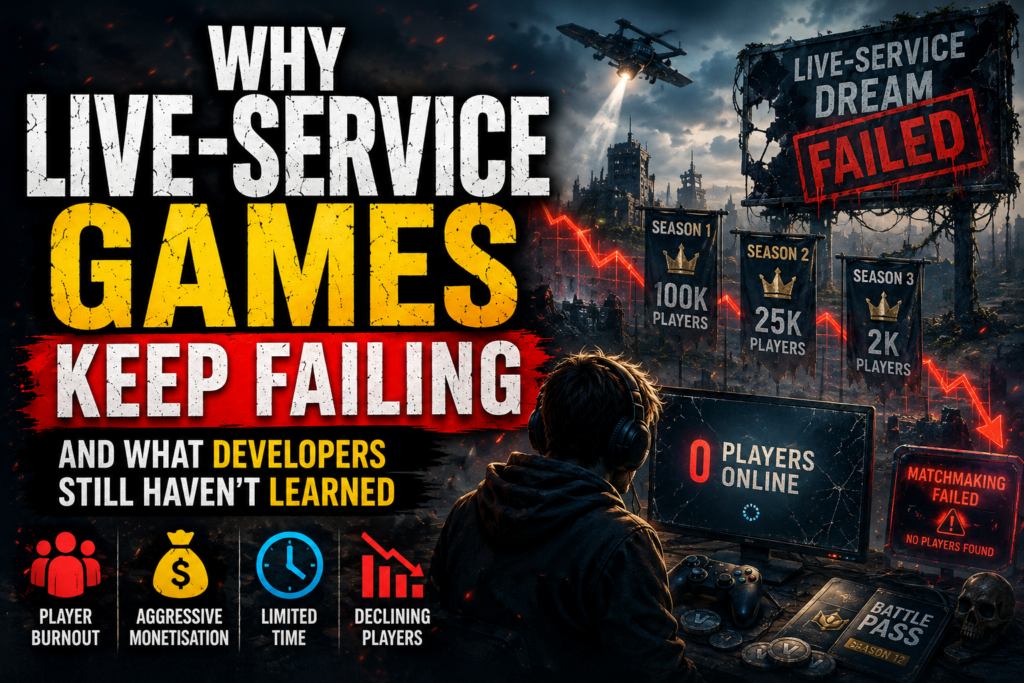
Live-service games keep failing because the industry has produced far more games competing for players’ limited time than those players can realistically support. The biggest problem isn’t the live-service model itself, it’s that too many developers try to manufacture long-term engagement through constant updates, monetisation and content schedules before creating a game that is genuinely compelling enough to keep players coming back. In 2026, player retention, a distinctive identity, strong gameplay and sustainable development matter more than ever, and recent failures show just how expensive it can be to get that formula wrong.
For years, live-service gaming was presented as the future.
- Build a game once.
- Keep adding content.
- Keep players engaged.
- Sell battle passes, skins, expansions and characters.
- Repeat the process for years.
- It sounded almost too good to be true.
And for a handful of games, it worked spectacularly.
- Fortnite.
- League of Legends.
- Destiny.
- Genshin Impact.
- Final Fantasy XIV.
These games demonstrated that a video game could become something much bigger than a traditional release.
- It could become a platform.
- A community.
- A hobby.
- Sometimes even a player’s primary game.
- And that’s precisely where the industry made its biggest mistake.
Publishers looked at the winners and assumed the formula was repeatable. It wasn’t.
The Live-Service Gold Rush

The basic idea behind live-service gaming is actually incredibly sensible.
Instead of releasing a game and moving on to the next project, developers continue supporting it with:
- New characters
- Maps
- Weapons
- Events
- Seasons
- Storylines
- Cosmetics
- Challenges
- Competitive modes
- Expansions
Players get a game that evolves, developers get recurring revenue, and everyone wins.
In theory.
The problem is that the economics encourage publishers to chase the enormous successes.
- When Fortnite became a cultural phenomenon, everyone wanted their own Fortnite.
- When Genshin Impact demonstrated how profitable an open-world gacha game could become, the market filled with games chasing that audience.
- When Destiny demonstrated the potential of a long-running shooter, suddenly every major publisher seemed interested in building one.
The result?
An enormous number of games fighting for exactly the same resource:
Your free time.
And unlike money, players can’t manufacture more of it.
Players Don't Have Infinite Time

This might be the single biggest problem with the modern live-service industry.
Imagine you’re an average gamer.
- You have work.
- School.
- Family.
- Friends.
- Other hobbies.
Maybe you already play:
- Fortnite
- Call of Duty
- Minecraft
- World of Warcraft
- Genshin Impact
- Final Fantasy XIV
- Destiny 2
- Roblox
- League of Legends
Now another publisher tells you:
“Here’s our brand-new live-service game. Please dedicate several hours every week to it.”
Why?
What exactly is going to make you abandon the games you’re already playing?
That’s the question developers increasingly need to answer.
Industry veteran Scott Hartsman described the current market as highly saturated, with successful games taking enormous amounts of players’ time while unsuccessful games can disappear rapidly.
And that’s the uncomfortable truth.
A new live-service game isn’t competing against other new releases.
It’s competing against everything players already love.
Launching Big Isn't Enough Anymore

One of the biggest misconceptions surrounding live-service development is that a huge launch automatically means you’ve succeeded.
- It doesn’t.
- A massive launch can actually be misleading.
A game might attract:
1 million players in its first week.
That sounds incredible.
But what happens three months later?
- Are 800,000 still playing?
- 500,000?
- 100,000?
- 10,000?
For a live-service game, that second number may matter more than the first.
Research and industry analysis increasingly point towards retention and churn as the critical problem facing live-service games.
Because a live-service game doesn’t simply need players. It needs players who keep returning, and that’s much harder.
The Retention Trap

Here’s where things become particularly difficult.
- A developer launches a game.
- Players arrive.
- The first season begins.
- Players complete it.
- Some leave.
The developer releases another season, more players leave. So the developer increases the amount of content. Then players complain that the game feels like a second job.
- The developer adds more rewards.
- Players complain about FOMO.
- The developer adds another battle pass.
- Players complain about monetisation.
- The developer adds more events.
Eventually the game becomes an enormous machine designed to keep players logging in.
But somewhere along the way… the game stops being fun.
FOMO Isn't The Same As Engagement

This is another lesson the industry desperately needs to learn.
There’s a difference between:
“I want to play this.”
and
“I have to play this.”
Limited-time events, seasonal rewards and battle passes can be effective, but if players feel like they’re constantly being punished for taking a break, the relationship changes.
Gaming becomes an obligation, you aren’t logging in because you want to.
You’re logging in because:
“If I don’t do this tonight, I’ll miss the reward.”
That can create short-term engagement.
But it doesn’t necessarily create long-term affection for a game, and players are becoming increasingly aware of that distinction.
Monetisation Can Destroy Trust

Let’s be clear:
Live-service games need to make money.
- Servers cost money.
- Developers need salaries.
- New content requires production teams.
- Customer support isn’t free.
- Nobody should expect a multiplayer game to operate indefinitely without revenue.
The problem is how that revenue is generated.
There is a massive difference between:
“Here’s an optional cosmetic if you’d like to support the game.”
and:
“Here’s a progression system deliberately designed to make you uncomfortable unless you spend.”
Players notice, and once trust disappears, it’s extremely difficult to rebuild.
The "Everything Must Be Live-Service" Problem

Perhaps one of the strangest developments of the past decade has been the assumption that virtually every successful franchise could become a live-service game.
But not every game needs:
- Battle passes
- Daily quests
- Seasonal content
- Microtransactions
- Limited-time events
- Constant progression
- Weekly challenges
Sometimes a game is better when it simply… ends.
A brilliant 20-hour single-player game doesn’t need to become a 500-hour service. A fantastic co-op game doesn’t necessarily need six years of seasonal content, and a franchise doesn’t automatically become more valuable because players can spend money on it every month.
Developers Are Copying Features Instead of Experiences

This is one of the biggest mistakes in modern game design. A successful game launches, and publishers analyse it.
They identify:
- Battle pass.
- Skins.
- Seasons.
- Daily challenges.
- Limited-time events.
- Premium currency.
Then another game gets built containing all those things, but here’s the problem. Those aren’t necessarily the reasons the original game succeeded. They’re simply the visible features surrounding it.
The real reason players stay might be:
- Incredible gunplay
- Fantastic movement
- A unique world
- Strong social interaction
- Deep progression
- Brilliant competitive design
- Memorable characters
- An exceptional gameplay loop
Copying the monetisation model doesn’t reproduce the magic.
You Can't Manufacture A Community

The greatest live-service games develop communities that feel bigger than the game itself.
Players create:
- Memes
- Guides
- YouTube videos
- Tournaments
- Fan art
- Discord communities
- Esports scenes
- Friend groups
- Stories
That community becomes part of the product, but you can’t simply order it from the marketing department.
You can’t say:
“We need a passionate community by September.”
It doesn’t work like that.
Community is earned, and it’s earned through years of trust.
Concord Wasn't Just A Game Failure
One of the clearest examples is Concord.
Sony’s hero shooter launched in August 2024 and was shut down just two weeks later after extremely low player numbers.
Firewalk Studios was subsequently closed.
The lesson wasn’t simply:
“Hero shooters are dead.”
That would be far too simplistic.
The real lesson was that entering an already crowded genre requires an extraordinarily compelling reason for players to switch. You’re not asking players to try a new game in isolation. You’re asking them to leave something else behind, and that is an incredibly difficult proposition.
Highguard Shows How Quickly Things Can Collapse
The live-service problem became even more obvious in 2026.
Highguard launched with considerable attention but rapidly lost players and ultimately shut down less than two months after launch. Recent reporting has highlighted the dramatic speed of that collapse.
- That’s brutal.
- Imagine spending years creating a multiplayer game.
- Hiring developers.
- Building infrastructure.
- Creating marketing campaigns.
- Launching worldwide.
- And then discovering that players have already moved on.
For a traditional single-player game, a disappointing launch can sometimes be followed by patches, sales and a long tail.
For a live-service game, the clock is ticking immediately.
2XKO Is Another Warning Sign
And this problem isn’t restricted to smaller studios.
Riot Games announced in August 2026 that it would cease active development on 2XKO by the end of the year after determining that player engagement had remained too flat and operating costs were substantially higher than the revenue the game generated. Riot plans to keep servers online beyond 2026 and unlock playable characters.
Think about that for a moment.
This is Riot Games.
The company behind one of the most successful live-service games in history.
The lesson is important:
Even experts can’t guarantee a live-service hit.
But Live-Service Games Aren't Dead

Here’s where I don’t want this article to become another:
“LIVE SERVICE IS DEAD!!!”
headline.
Because it isn’t.
That’s nonsense.
Some of the biggest games in the world remain live-service titles.
The model itself works.
The problem is how difficult it is to make it work.
Games such as Fortnite, League of Legends, Final Fantasy XIV and Genshin Impact have demonstrated that players absolutely will commit enormous amounts of time to evolving games.
So the question isn’t:
“Do players want live-service games?”
It’s:
“Which live-service games are actually worth making room for?”
That’s a very different question.
The Games That Get It Right
The successful games tend to have something important in common.
They have a strong identity.
You can explain why they exist.
Fortnite
Constant experimentation and a massive social ecosystem.
Final Fantasy XIV
A huge RPG adventure built around story, community and long-term progression.
League of Legends
Extremely deep competitive gameplay with an enormous ecosystem surrounding it.
Genshin Impact
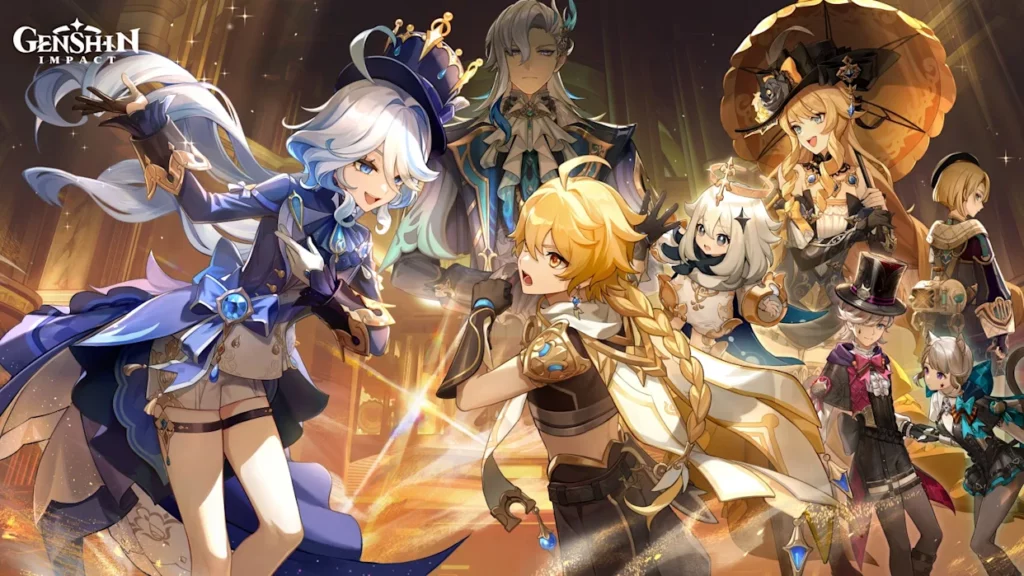
Exploration, characters, world-building and regular content releases combine into a compelling package.
The important point is that the live-service structure isn’t the reason these games are successful.
It’s the game underneath it.
Build The Game First
This might sound obvious, but it’s perhaps the most important lesson.
Make a great game.
Then ask how continued content can improve it.
Not:
“How can we monetise this for the next ten years?”
- Then build the game around that question.
- Players can feel the difference.
- If the foundation is excellent, people want more.
- If the foundation is mediocre, no amount of seasonal content is going to magically fix it.
Stop Launching Games Before They’re Ready
Technical problems are particularly dangerous for live-service games.
Why?
Because the first impression is everything, players have thousands of alternatives.
If your new multiplayer game launches with:
- Server problems
- Crashes
- Poor optimisation
- Broken matchmaking
- Missing features
- Balance problems
players don’t necessarily wait six months for you to fix it.
They simply leave, and then they may never return.
Recent reporting around Highguard and other failed live-service launches repeatedly highlights how difficult it is to recover when the initial experience doesn’t meet expectations.
The First Month Matters, But The First Hour Matters More

There’s another misconception here.
Developers often talk about:
- 90-day roadmaps.
- Year-one content.
- Three-year plans.
Players don’t care about your five-year roadmap if the first hour isn’t enjoyable.
The opening experience needs to answer a simple question:
Why should I keep playing?
Not:
“What rewards will I unlock in 27 days?”
That’s backwards.
The Community Should Be Part of Development

One of the biggest advantages of live-service games is the ability to respond to players, but listening isn’t the same as collecting feedback.
If thousands of players tell developers:
“This system isn’t fun.”
and the response is:
“Our engagement data says otherwise.”
eventually the relationship breaks down.
The best live-service games create a genuine feedback loop.
- Players explain what isn’t working.
- Developers respond.
- Changes happen.
- Players see that their feedback matters.
- Trust grows.
What Should The Future Of Live-Service Gaming Look Like?
I don’t think the future is the death of live-service gaming. I think it’s smaller, smarter, and more sustainable live-service gaming.
We could see more games moving towards the following:
Smaller teams
Rather than hundreds of developers maintaining enormous content pipelines.
Longer development cycles
Making sure the foundation is strong before launch.
Meaningful updates
Fewer updates that actually matter rather than endless filler.
Community servers
Giving games longer lives without requiring publishers to maintain every aspect indefinitely. Tripwire’s approach with Deceive Inc. is an interesting example of publishers reconsidering how multiplayer games can remain accessible without relying entirely on traditional live-service infrastructure.
More co-operative games
Not every multiplayer experience needs to be a competitive seasonal treadmill.
Optional monetisation
Allowing players to support games without constantly pressuring them to spend.
The Biggest Lesson Developers Need To Learn

Here’s the fundamental problem:
Players don’t owe your game their time.
That’s it, that’s the lesson.
Players aren’t required to play your game because you’ve spent £200 million making it.
- They don’t owe you ten hours a week.
- They don’t owe you battle-pass purchases.
- They don’t owe you a second season.
- They don’t owe you a second chance.
You have to earn their attention, and in 2026, that attention is more valuable than ever.
GhettoSmurf Gaming’s Live-Service Survival Checklist
Before launching another live-service game, developers should be asking:
1. Is the core gameplay genuinely fun?
- Not monetised.
- Not optimised.
- Fun.
2. Does this game have an identity?
Can players explain what makes it different?
3. Why will players choose this over existing games?
This is perhaps the most important question.
4. Can the studio actually maintain it?
A ten-year plan means nothing if the team cannot afford year three.
5. Is the monetisation fair?
Players should feel like customers, not targets.
6. Is there enough content at launch?
Not necessarily hundreds of hours.
Just enough to establish a strong foundation.
7. Can players take a break?
If missing one week destroys your progression, you’re designing addiction rather than engagement.
8. Are you listening to the community?
And more importantly, are you willing to change something when they’re right?
GSG Awards:

Best Example of Long-Term Live-Service Success
Final Fantasy XIV
A reminder that a live-service game can build genuine loyalty when the underlying experience is strong enough.
Best Example of Constant Reinvention
Fortnite
Epic repeatedly transforms the game rather than simply releasing more of the same.
Best Lesson From Failure
Concord
Not because it was uniquely terrible, but because it demonstrated just how difficult it is to enter a saturated market without a compelling reason for players to switch.
Most Important Industry Warning of 2026
2XKO
If Riot cannot sustain a promising live-service fighting game despite its enormous industry experience, nobody should assume success is guaranteed.
GSG Reflection
The future of live-service gaming isn’t about making players play forever. It’s about making them want to come back tomorrow.
There’s an enormous difference between those two ideas.
One is a business strategy, the other is game design, and players can tell when they’re being treated as numbers rather than gamers.
Nothing else in gaming delivers the same feeling as stepping into a living online world filled with thousands of other players, and judging by current player numbers, millions of gamers still agree.
Community Question
What live-service game do you think actually gets it right?
Is it:
- Fortnite?
- Final Fantasy XIV?
- Genshin Impact?
- Destiny?
- League of Legends?
Or something completely different, and here’s the more interesting question:
What is the one thing that would make you quit a live-service game permanently?
Tell us in the comments.
Final Verdict
Live-service games aren’t failing because players have stopped wanting long-term games. They’re failing because the industry has created an overcrowded market where only the games capable of earning and retaining a player’s attention can survive.
The solution isn’t necessarily to abandon live-service gaming. It’s to stop treating the model as the product. Build something people genuinely love first, then give them reasons to return.
- Don’t make players feel like they’re clocking into work.
- Don’t bury good gameplay underneath monetisation.
- Don’t assume a famous IP guarantees success.
- Don’t launch before the game is ready.
And above all:
Stop asking players how long they can stay.
Start asking why they’d want to come back. That’s the lesson the live-service industry keeps learning the hard way, and judging by what we’re seeing in 2026, it’s a lesson developers are finally being forced to take seriously.
At GhettoSmurf Gaming, we’ll keep bringing you the Latest trends, Gear reviews, Anime Reviews, Game Reviews and setup ideas to help you level up without emptying your wallet. Stay tuned weekly for more gaming insights!
FAQs: Why Live-Service Games Keep Failing
1. Why do live-service games keep failing?
Live-service games keep failing because the market is overcrowded, players have limited time, and many games struggle to provide a compelling reason to keep playing. Poor retention, aggressive monetisation, technical problems and repetitive content can make the problem even worse.
2. Are live-service games dying?
No, live-service games are not dying, but the market is becoming much harder to succeed in. Established games such as Fortnite, League of Legends, Final Fantasy XIV and Genshin Impact demonstrate that players still enjoy long-term games when they offer compelling gameplay and regular meaningful content.
3. What is the biggest problem with live-service games?
The biggest problem is competition for player attention. Most gamers already have limited free time and may already be invested in one or more live-service games, making it extremely difficult for a new title to earn a permanent place in their routine.
4. Why do players quit live-service games?
Players commonly leave live-service games because of repetitive content, excessive grinding, aggressive monetisation, technical problems, poor updates, burnout or simply because another game offers a more enjoyable experience.
5. Can live-service games still succeed in 2026?
Yes. Live-service games can still succeed in 2026, but developers need a strong core game, a clear identity, sustainable content plans, fair monetisation and a genuine understanding of what their community wants.

Why Live-Service Games Keep Failing in 2026 and What Developers Get Wrong
Why do live-service games keep failing despite massive budgets and...
Read More
The Seven Deadly Sins Origin Review — A Beautiful Anime World Held Back by Bugs and Grind
The Seven Deadly Sins: Origin Review — A Beautiful Anime...
Read More
The Rise of Cosy Games: Why Millions of Gamers Are Choosing Relaxation Over Competition in 2026
Cosy games have become one of the biggest trends in...
Read More