

Why So Many AAA Games Feel Worse in 2026
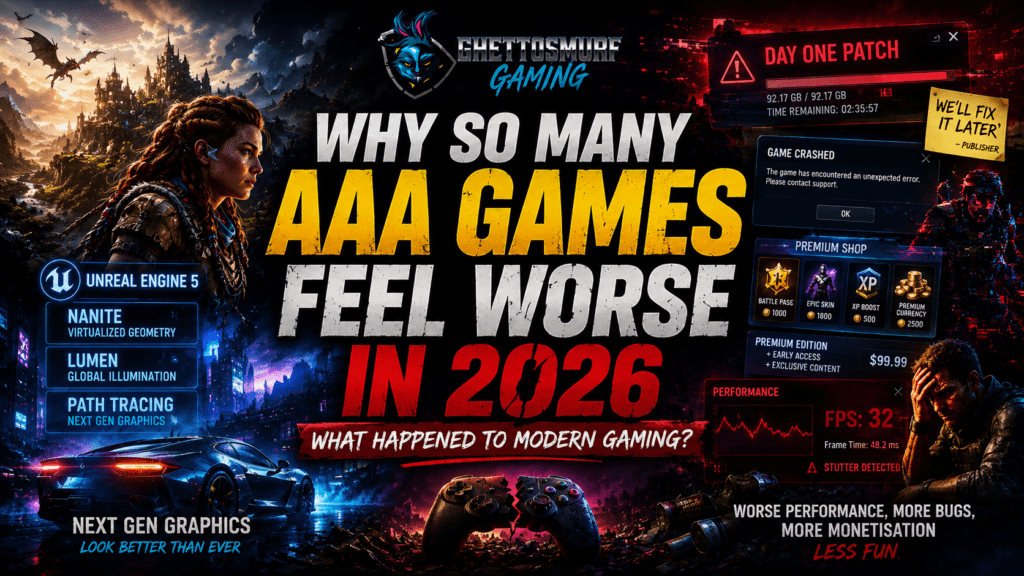
Gaming graphics have never been better.
Character models are more realistic than ever. Worlds are larger, more detailed, and packed with advanced lighting technologies. Ray tracing, path tracing, photorealistic textures, and AI-powered upscaling have pushed visual fidelity to incredible heights.
And yet…
A growing number of gamers feel that modern AAA games 2026 are becoming less enjoyable to play.
Browse Steam reviews, Reddit discussions, YouTube comment sections, or gaming forums and you’ll find the same complaints appearing again and again:
- Poor optimisation
- Stuttering performance
- Day-one patches
- Aggressive monetisation
- Live-service fatigue
- Always-online requirements
The strange reality of AAA games 2026 is that while games look better than ever, many players believe the overall gaming experience has actually become worse.
So what happened?
Games Have Never Looked Better

It’s impossible to deny the technical achievements of modern gaming.
Technologies such as:
- Unreal Engine 5
- Nanite virtualised geometry
- Lumen global illumination
- Path tracing
- AI upscaling
have allowed developers to create worlds that would have seemed impossible just a few years ago.
Games today feature:
- Near-photorealistic environments
- Massive draw distances
- Dynamic weather systems
- Real-time lighting
- Highly detailed character animations
The visual leap from 2016 to 2026 is undeniable.
Yet many gamers would argue that graphical progress has come with a cost.
Graphics Have Improved Faster Than Performance

One of the biggest frustrations facing PC gamers today is that hardware improvements often feel smaller than expected.
A gamer can spend thousands on a modern gaming PC and still encounter:
- Shader compilation stutter
- Frame pacing issues
- CPU bottlenecks
- Texture streaming problems
- Random hitching
Even powerful systems featuring modern GPUs can struggle to maintain smooth frame rates in some newly released titles.
Part of the issue is that graphical ambition has accelerated faster than optimisation.
Developers now have access to incredibly powerful tools that allow them to create larger and more detailed worlds than ever before. However, optimising those worlds across thousands of different hardware configurations remains an enormous challenge.
As a result, many modern releases launch looking spectacular while performing inconsistently.
For gamers, that disconnect can be frustrating.
Beautiful visuals mean very little when the gameplay experience feels unstable.
The Day-One Patch Culture Problem

There was a time when games had to be finished before they shipped.
Physical discs were pressed, packaged, and sold with little opportunity to fix major issues after launch.
Today, that reality no longer exists.
Modern developers can deploy updates instantly, which has created a culture where many games launch in a state that feels unfinished.
Gamers have become accustomed to:
- 50GB updates
- 100GB day-one patches
- Emergency hotfixes
- Weeks of post-launch bug fixing
Several major releases over the past few years have highlighted this issue.
Titles such as:
- Cyberpunk 2077
- Cities: Skylines II
- Star Wars Jedi: Survivor
- Redfall
all faced criticism for technical issues at launch.
While many of these games improved significantly over time, first impressions matter.
Players are increasingly asking a simple question:
Why are consumers paying full price to act as beta testers?
Unreal Engine 5: Incredible Technology, Frustrating Results

Few technologies have generated as much excitement as Unreal Engine 5.
When Epic Games first showcased the engine, the gaming community was amazed.
The promise was clear:
- Better visuals
- Larger worlds
- More realistic environments
- Faster development
In many ways, UE5 has delivered.
However, it has also become associated with a growing list of technical complaints.
These include:
Shader Compilation Stutter
Many games compile shaders while players are actively playing, causing noticeable stuttering.
Traversal Stutter
Moving through large environments can trigger asset loading issues that impact frame pacing.
CPU Bottlenecks
Advanced rendering techniques often place heavy demands on processors.
It’s important to be fair here.
Unreal Engine 5 itself is not the problem.
The engine is capable of producing fantastic results.
The challenge is that many development teams are still learning how to optimise projects effectively within UE5’s demanding framework.
As developers gain more experience, these issues will likely improve.
But for now, Unreal Engine 5 remains both one of gaming’s greatest achievements and one of its most common sources of frustration.
Live-Service Games Changed Everything

Perhaps the biggest shift in modern gaming isn’t technical.
It’s philosophical.
For decades, developers sold games.
Today, many publishers sell engagement.
The rise of live-service gaming has fundamentally changed how many AAA titles are designed.
Modern games often include:
- Battle passes
- Daily challenges
- Seasonal events
- Premium currencies
- Login rewards
- Limited-time cosmetics
The goal is no longer simply to entertain players.
The goal is to keep players returning every day.
This creates an important question:
Are games being designed around fun, or around retention metrics?
For some players, live-service systems provide long-term goals and ongoing content.
For others, they feel like a second job.
Monetisation Is Everywhere

AAA gaming has become increasingly expensive.
Development costs have skyrocketed.
Teams are larger.
Projects take longer.
Budgets often exceed hundreds of millions of pounds.
Publishers argue that monetisation helps offset these costs.
Players, however, often see things differently.
Today it’s common to encounter:
- £70 base games
- Deluxe editions
- Premium editions
- Battle passes
- Cosmetic stores
- XP boosters
- Early access purchases
Many gamers feel they’re being asked to pay multiple times for the same experience.
The issue isn’t necessarily that monetisation exists.
The issue is how frequently it appears.
When players spend premium prices, they increasingly expect premium experiences without additional layers of monetisation.
Bigger Games, Less Polish

AAA games 2026 have become enormous.
Modern open worlds can contain:
- Hundreds of hours of content
- Thousands of quests
- Vast landscapes
- Millions of lines of code
While this scale is impressive, it also creates significant challenges.
Every additional feature increases the complexity of testing.
Every new system introduces more opportunities for bugs.
Every larger map creates more performance variables.
The result is that many modern games launch with impressive scale but less refinement.
Some of the most beloved games in history weren’t necessarily the biggest.
They were simply polished.
Bigger doesn’t automatically mean better.
Why Indie Games Are Winning Hearts

While AAA studios chase larger budgets and bigger worlds, many indie developers are focusing on something much simpler:
Making fun games.
Titles like:
- Hades
- Vampire Survivors
- Balatro
- Deep Rock Galactic
- Lethal Company
have demonstrated that creativity often matters more than budget.
These games succeed because they prioritise:
- Strong gameplay loops
- Clear design goals
- Fair pricing
- Good performance
- Player enjoyment
Many gamers are discovering that they don’t necessarily need cutting-edge graphics to have memorable experiences.
They simply need games that respect their time and deliver consistent fun.
What Gamers Actually Want
The gaming community isn’t demanding perfection.
Most players understand that game development is incredibly difficult.
What gamers want is surprisingly reasonable.
They want:
✓ Stable performance
✓ Complete launches
✓ Fair monetisation
✓ Engaging gameplay
✓ Respect for their time
What many players don’t necessarily want is:
✗ Larger maps
✗ More battle passes
✗ More currencies
✗ More grind
✗ More graphical fidelity at the expense of performance
The industry’s challenge moving forward isn’t creating bigger games.
It’s creating better experiences.
Final Thoughts
The truth is that AAA gaming 2026 isn’t dying.
Far from it.
Some of the biggest and most ambitious games ever created are being released right now.
But the frustrations players are expressing are real.
The industry has become so focused on scale, engagement metrics, monetisation systems, and graphical advancement that some developers seem to have lost sight of what made gaming special in the first place.
The problem isn’t that AAA games 2026 are bad.
The problem is that expectations have risen faster than quality.
Gamers aren’t asking for perfection.
They’re asking for finished products.
And until more publishers recognise that, the conversation surrounding modern AAA gaming is unlikely to change.
At GhettoSmurf Gaming, we’ll keep bringing you the Latest trends, Gear reviews, Anime Reviews, Game Reviews and setup ideas to help you level up without emptying your wallet. Stay tuned weekly for more gaming insights!
FAQs: AAA games 2026
Why do modern AAA games launch with so many bugs?
Modern games are significantly larger and more complex than older titles. Combined with publisher deadlines and post-launch patching capabilities, this often leads to unfinished releases reaching consumers.
Is Unreal Engine 5 causing performance problems?
Not directly. Unreal Engine 5 is a powerful engine, but developers are still learning how to optimise games effectively using its advanced technologies.
Why do gamers dislike battle passes?
Many players feel battle passes create pressure to play regularly and can make games feel more focused on engagement metrics than fun.
Are indie games better than AAA games 2026?
Not necessarily. However, many indie games prioritise gameplay, creativity, and optimisation, which resonates strongly with modern gamers.
Will AAA gaming improve in the future?
Likely yes. As developers gain more experience with new technologies and player feedback continues shaping the industry, optimisation and game quality should improve over time.

WORLD OF WARCRAFT RETAIL: MY LOVE-HATE RELATIONSHIP WITH AZEROTH
I've played Warcraft for almost half my life. From discovering...
Read More
Why SWTOR Survived by Becoming a Story-First MMO
Why has SWTOR survived while so many other MMOs have...
Read More
World of Warcraft Forever: Blizzard Is Rebuilding Classic Without Losing What Made It Special
World of Warcraft Forever is changing Classic in a big...
Read More
[…] incredible visuals, deep combat systems, engaging stories and production values that rival some of the biggest AAA releases in […]
[…] to push microtransactions at every opportunity. Many rival, and sometimes surpass, full-priced AAA releases in terms of gameplay, longevity, and community […]
[…] considered a niche genre, cosy games in 2026 have evolved into one of the most popular movements in modern gaming. They prioritise relaxation, creativity and personal enjoyment over competition, proving that a […]
[…] a traditional single-player game, a disappointing launch can sometimes be followed by patches, sales and a long […]