

The Truth About AI in Gaming. Is It Helping or Killing Creativity?
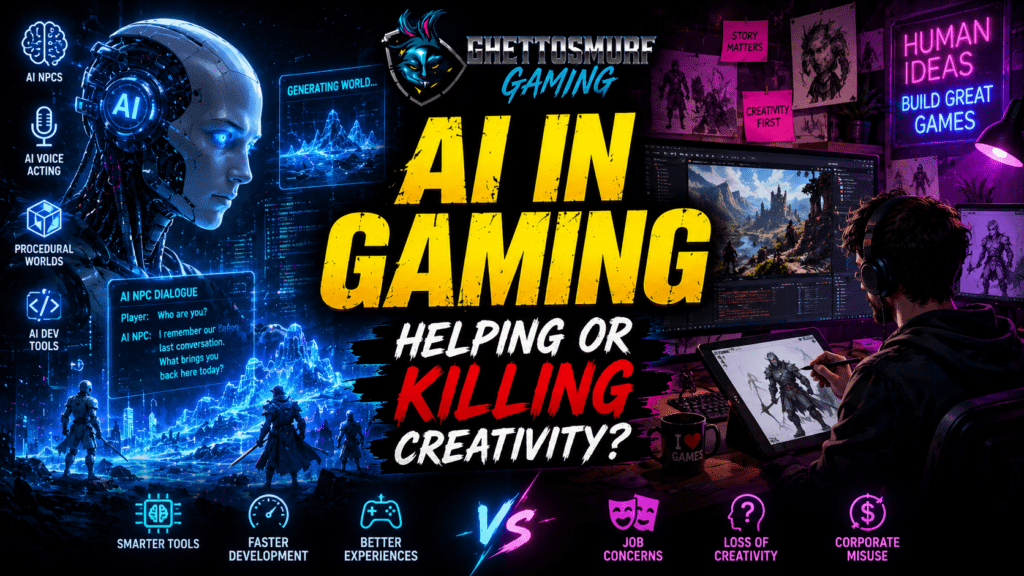
Artificial intelligence is no longer some distant futuristic concept.
It’s already shaping the games we play every day.
Whether it’s enemies adapting to our actions, NPCs responding more naturally, worlds generating themselves dynamically, or developers using AI tools to speed up production, artificial intelligence is becoming one of the most influential technologies in gaming.
Yet its rapid rise has also sparked fierce debate.
Some gamers believe AI could revolutionise game development and create more immersive experiences than ever before.
Others fear it could replace human creativity, damage storytelling, and transform gaming into something soulless and algorithm-driven.
So who’s right?
The truth is far more complicated than many people realise.
AI Has Been In Gaming Longer Than You Think

When most people hear the term AI, they immediately think of chatbots, image generators and large language models.
But gaming has relied on artificial intelligence for decades.
Every time an enemy takes cover during a firefight, follows a patrol route, or reacts to your presence, AI in gaming is at work.
Some of gaming’s most memorable AI systems appeared long before today’s AI boom.
Examples include:
- The dynamic Director system in Left 4 Dead
- The terrifying Xenomorph behaviour in Alien: Isolation
- The adaptive enemy squads in F.E.A.R.
- Strategy game opponents that react to player decisions
The difference is that traditional game AI was carefully scripted by developers. Modern AI in gaming aims to generate behaviour dynamically. That shift could change gaming forever.
The Rise Of AI NPCs
Imagine walking into a medieval tavern in an RPG.
Instead of hearing the same three dialogue lines repeated endlessly, every character remembers previous conversations, reacts to your choices and develops unique relationships with your character.
That’s the promise of AI-powered NPCs.
Recent advancements in language models have made it possible for NPCs to:
- Hold natural conversations
- Remember past interactions
- Generate unique responses
- Adapt to player behaviour
For open-world games and MMORPGs, the possibilities are enormous.
NPCs could become genuinely unpredictable and responsive rather than acting like static quest dispensers.
However, there are legitimate concerns.
Human writers spend years crafting memorable characters and meaningful dialogue.
Can an AI truly replicate the emotional depth of a character like Garrus Vakarian, Arthur Morgan, or Geralt of Rivia?
Many gamers remain sceptical, and rightly so. Technology can create conversations. Creating meaningful storytelling is far more difficult.
AI Voice Acting Is Dividing The Industry

Perhaps no aspect of AI in gaming has sparked more controversy than voice acting.
AI-generated voices have improved dramatically over the past few years.
Developers can now create dialogue faster and cheaper than ever before.
The potential benefits are obvious:
- Lower development costs
- Faster localisation
- More dialogue options
- Easier content updates
But many voice actors view AI as a direct threat to their profession. Some fear studios could eventually replace human performers entirely. Beyond employment concerns, there is also the question of quality.
The best voice performances deliver emotion, nuance and personality.
While AI voices continue to improve, many still struggle to capture the authenticity that talented human actors bring to a role.
The debate is unlikely to disappear anytime soon.
Procedural Generation Is Becoming Smarter
Procedural generation has existed for years.
Games like Minecraft and No Man’s Sky have demonstrated how algorithms can create enormous worlds without developers having to build every inch by hand.
But AI in gaming is taking procedural generation to another level.
Future systems may be capable of generating:
- Entire questlines
- Dungeons
- Cities
- NPC backstories
- Dynamic events
- Unique story arcs
On paper, this sounds incredible.
Infinite content has always been one of gaming’s ultimate goals.
The problem is that more content doesn’t automatically mean better content. Many procedurally generated experiences struggle to match the quality of carefully designed handcrafted worlds. Players often remember memorable moments, not endless ones.
That’s a distinction many AI advocates overlook.
AI Development Tools Are Changing Game Creation

While gamers often focus on AI-generated content, some of the biggest changes are happening behind the scenes.
Developers are increasingly using AI tools for:
- Programming assistance
- Asset creation
- Animation support
- Bug detection
- Quality assurance
- Workflow optimisation
These tools can significantly reduce development time.
Tasks that once took days may now take hours.
For developers facing tight deadlines and growing production costs, the appeal is obvious.
Yet there is a potential downside.
If every studio relies on similar AI tools, will games begin to feel more alike? The gaming industry already struggles with formulaic design. The last thing players want is AI accelerating that trend.
Why Indie Developers Could Benefit The Most

Ironically, the biggest winners from AI in gaming may not be massive AAA publishers. They may be independent developers. Small studios often have brilliant ideas but limited budgets.
AI tools could help bridge that gap.
A team of five developers may soon have access to tools that previously required hundreds of employees.
This could lead to:
- More experimentation
- Faster prototyping
- Greater creativity
- Lower development costs
History shows that some of gaming’s most innovative ideas come from smaller studios. AI may allow even more independent creators to compete with industry giants.
That possibility should excite gamers.
The Real Threat Isn't AI
The most important thing to understand with AI in gaming is this:
AI itself is not the problem.
Like any tool, its impact depends entirely on how people choose to use it.
A hammer can build a house, or break a window.
Artificial intelligence is no different.
Used responsibly, AI can:
- Reduce repetitive tasks
- Improve accessibility
- Create richer worlds
- Help developers focus on creativity
Used poorly, AI can:
- Replace artists
- Encourage shortcuts
- Produce generic content
- Prioritise efficiency over quality
The future of gaming won’t be decided by algorithms. It will be decided by the developers, publishers and players who choose how those algorithms are used.
Final Thoughts
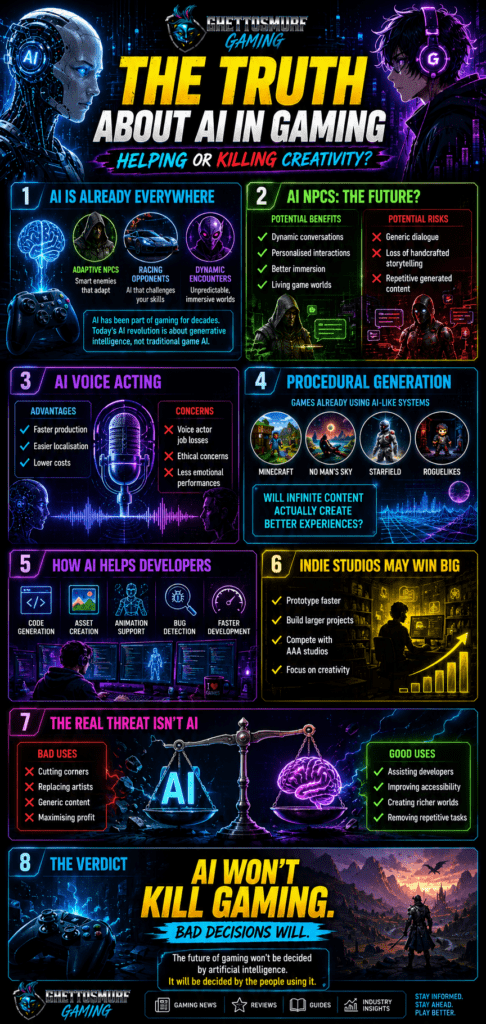
Artificial intelligence is already transforming gaming. There’s no stopping that.
The real question isn’t whether AI belongs in gaming.
It’s how much influence we should allow it to have.
The technology offers incredible opportunities.
Smarter NPCs.
More dynamic worlds.
Faster development.
Better accessibility.
But it also presents genuine risks.
Creativity has always been gaming’s greatest strength.
No matter how powerful AI becomes, it should never replace the imagination, passion and artistry that make great games memorable.
AI won’t kill gaming.
Bad decisions will.
Like every tool before it, artificial intelligence can either empower creators or replace them. The future of gaming won’t be decided by AI. It will be decided by the people using it.
At GhettoSmurf Gaming, we’ll keep bringing you the Latest trends, Gear reviews, Anime Reviews, Game Reviews and setup ideas to help you level up without emptying your wallet. Stay tuned weekly for more gaming insights!
FAQs: Ai In Gaming
Is AI already used in video games?
Yes. AI has been used in gaming for decades, but modern generative AI is significantly expanding its role.
What are AI NPCs?
AI NPCs are non-player characters that can respond dynamically to player actions and conversations.
Will AI replace game developers?
Unlikely. AI is more likely to assist developers rather than fully replace them, especially in creative roles.
Can AI create entire video games?
Parts of games can already be generated by AI, but fully AI-created games still require significant human involvement.
Is AI good or bad for gaming?
It depends on how it is used. AI can improve development and player experiences, but misuse could negatively impact creativity and quality.

WORLD OF WARCRAFT RETAIL: MY LOVE-HATE RELATIONSHIP WITH AZEROTH
I've played Warcraft for almost half my life. From discovering...
Read More
Why SWTOR Survived by Becoming a Story-First MMO
Why has SWTOR survived while so many other MMOs have...
Read More
World of Warcraft Forever: Blizzard Is Rebuilding Classic Without Losing What Made It Special
World of Warcraft Forever is changing Classic in a big...
Read More